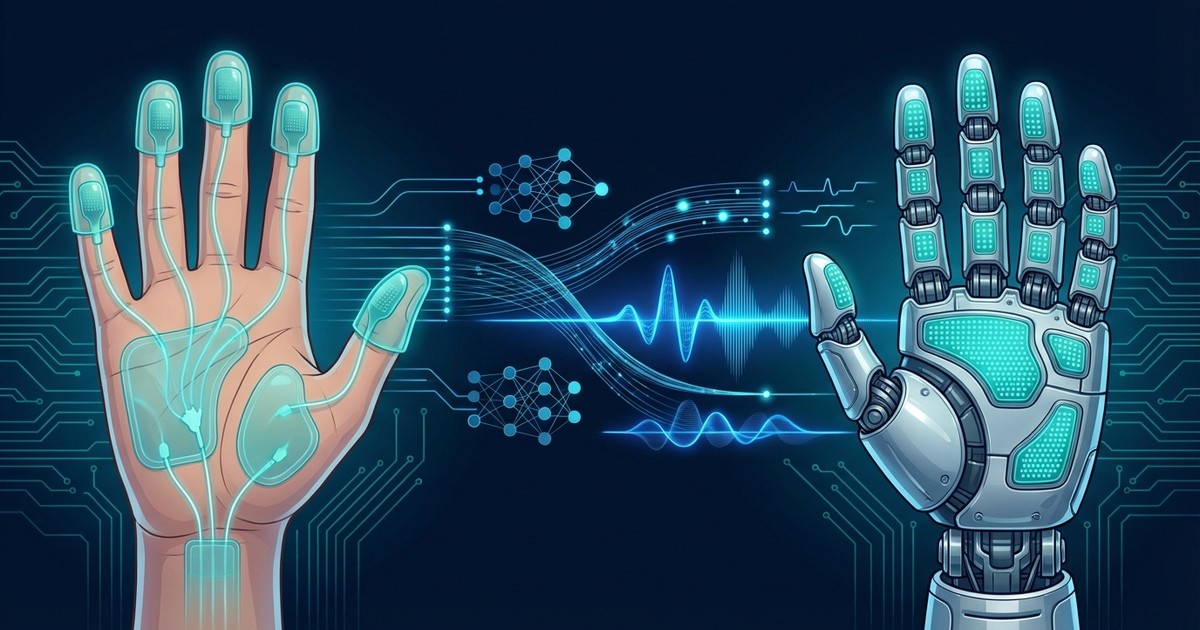
Tactile Sensing for Dexterous Robot Hand Manipulation: A Comprehensive Survey
From tactile sensors to contact control, VLA dexterity, and manual-work automation
A unified survey of tactile sensing, robot hands, tactile control, and learning transfer. — 5 Parts, 18 Chapters
First published: 2026-04-01 | Last updated: 2026-06-18
From Sensor to Data
Connects transduction, calibration, coordinate frames, and storage representations.
Tactile Control
Covers contact dynamics, slip/shear, multi-contact control, and force closure.
Manufacturing Outlook
Links commercial robot hands, Cosmax-style multi-object handling, and S6/S9 physical AI.
Part I: Foundations of Touch
Why Tactile Sensing — Giving Robots the Sense of Touch
Need for touch, human tactile system, history of robot tactile sensing
→ 02Tactile Sensor Technology — The Skin of Robots
Sensor transduction principles and the bridge from signals to data
→ 03Tactile Data — Turning Sensor Signals into Representations
Calibration, synchronization, frames, storage formats, and datasets
→Part II: Hands — Robot and Human
Robot Hand Design — Machines Built to Grasp
Multi-fingered hands, grippers, mechanism design
→ 05Intelligent Mechanisms — Physical Intelligence
Underactuation, VSA, and the commercial robot-hand landscape
→ 06Human Hand Data Collection — Teaching by Demonstration
Data gloves, exoskeletons, and EgoScale-style large-scale hand data
→ 07Haptic Feedback for Teleoperation — Returning Sensation to the Operator
Kinesthetic and tactile feedback, wearable haptics, and haptic-in-the-loop data collection
→Part III: Tactile-Based Control and Manipulation
Contact Dynamics — Reading Touch as a Control Input
Contact state, complementarity, impedance, and MPC control
→ 09Slip and Shear — Reacting Before the Grasp Fails
Slip detection, shear force, and internal-force control
→ 10Multi-Contact In-Hand Manipulation — Rearranging Inside the Hand
Finger gaiting, rolling, contact switching, and sequential multi-object grasping
→ 11Force Closure and Grasp Control — Closing the Force Space
Force/form closure, tactile grasp planning, and manufacturing-cell use
→Part IV: Learning and Transfer
Learning to Manipulate — Learning by Touch
RL, imitation learning, tactile-informed policies
→ 13Vision-Language-Action Models — See, Speak, Act
RT-2, OpenVLA, pi0, multimodal policies
→ 14Sim-to-Real Transfer — From Virtual to Reality
Domain randomization, tactile simulation
→ 15From Human to Robot — Embodiment Retargeting
Kinematic/visual retargeting, latent-space alignment
→Part V: Integration and Manufacturing Outlook
Research Integration — Toward Unified Systems
Research integration, systems perspective
→ 17Physical AI and the Industrial Outlook
Manual-work automation, quality, and deployment strategy
→ 18Limitations and Future Directions — Toward Manufacturing Physical AI
Limits, roadmap, and manufacturing-focused research directions
→